What's your FTP in minutes?
You know your threshold in watts. It is the number you test for, set your zones from, and watch across a season. Behind it sits a second quantity you have never been shown: the duration that threshold holds. No tool reports it, so you have carried it for years without a name and without a value. It is yours, it differs from one rider to the next, and it moves as you train. This is what it is, and how to read what a single ride does to it.
Every threshold has a duration
Every power test fixes a duration and reports a wattage. FTP is a twenty-minute effort reported as one number. A five-minute test estimates VO2max. A thirty-second Wingate measures anaerobic power. In each case the duration is an input the protocol holds constant, and the output is watts. You read the watts. The duration stays behind the number, assumed rather than measured, the same for every rider who takes the test.
The duration is not an arbitrary choice. It is chosen because each physiological threshold tends to express itself near a particular length of effort, and the protocols are built to sit close to those lengths. What the protocols do not do is ask where your threshold actually falls. They fix the duration in advance and measure only the watts you produce there. If your glycolytic threshold fires nearer to thirty-seven seconds than thirty, the thirty-second test does not tell you, and cannot, because thirty seconds was the assumption it started from.
So the duration has always been a real quantity, specific to you, sitting one layer beneath a number you check constantly. You have felt it on the days an effort held longer than it used to, and on the days it gave way sooner than you expected. You have simply never had it reported as a value you could read and track. The clearest place to see this is not an unfamiliar threshold but the one you already know best.
Start with the threshold you know
Of the seven thresholds PTA measures, one is already part of your vocabulary. It lives at the long, steady end of the seven thresholds, at the boundary between the effort you can hold and the effort that starts accumulating debt. PTA calls it PT-T. You call it your threshold, or your FTP.
Strictly, FTP is the power you can sustain at that threshold, conventionally placed near an hour and estimated from a twenty-minute test with a correction. The concept is older than the term. Threshold power is the power-meter era's practical stand-in for a steady-state boundary that lactate testing mapped first, in a lab, from blood samples. What the power meter added was reach: a usable number from a hard twenty-minute effort instead of a clinical protocol. In practice, that twenty-minute number is what most riders mean when they say their FTP, and today it is often produced without any deliberate test at all, modeled from the pattern of a rider's ordinary efforts.
Every one of those methods reports the same thing: the watts. None reports how long the threshold holds, because each one settled the duration before it began. The lactate protocol fixes a sampling schedule. The twenty-minute test fixes the clock at twenty minutes. A passive estimate inherits the same assumption. The length of time your threshold actually sustains has never been on the screen.
PT-T reports what FTP left out. Alongside the watts, it gives the duration the threshold holds, and that duration is a measurement, not an assumption. Consider the same race, the Restart Esports Wednesday Worlds, ridden three weeks apart on the same course. On June 10 the athlete's threshold seat was 19:09.5 and 382 watts. On July 1, after ten races in between, it read 19:01.7 and 383 watts.
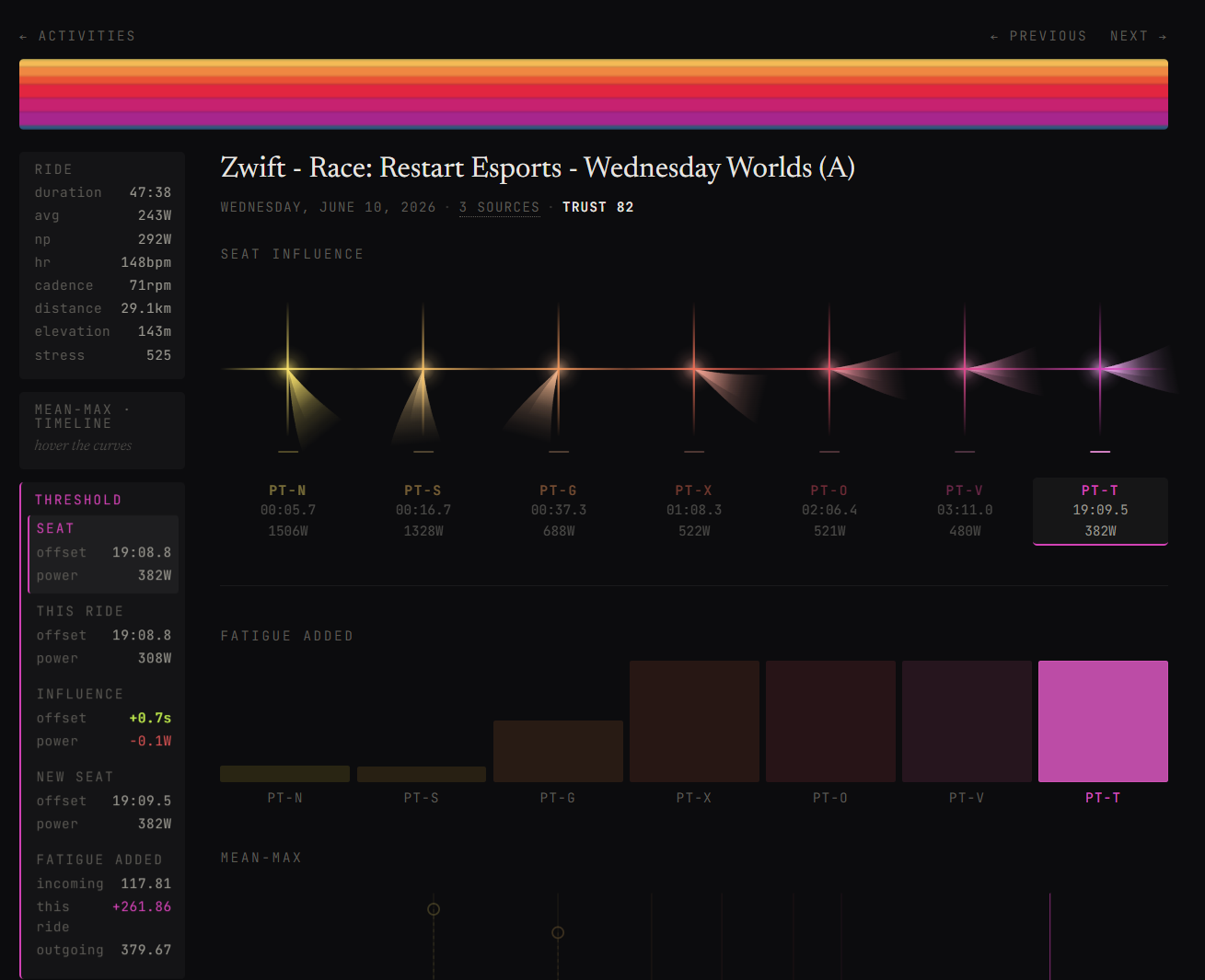
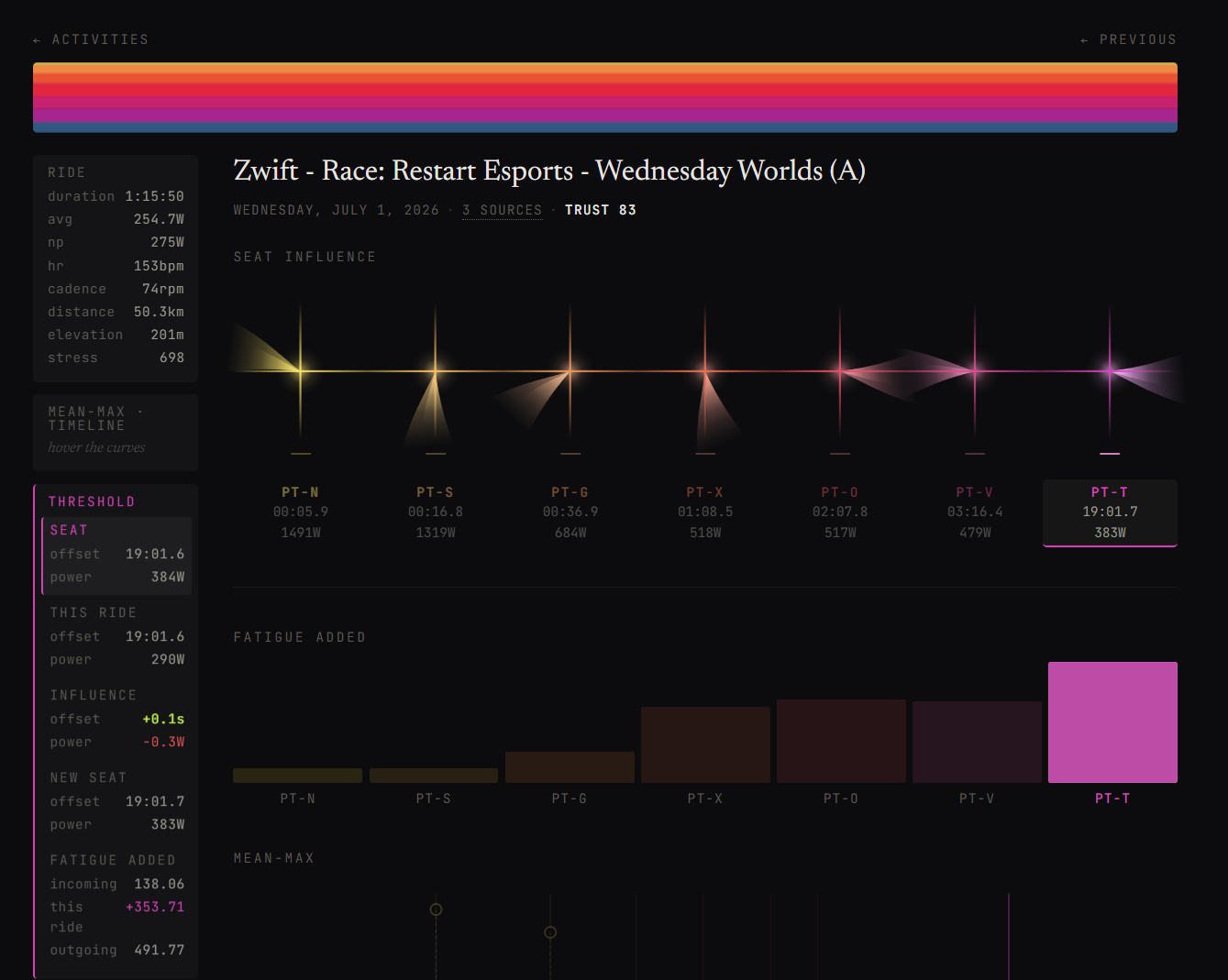
The two readings are different, and they are close. The power held within a watt, 382 then 383. The duration moved about eight seconds and stayed within a few seconds of nineteen minutes. This is not a claim that the threshold rose or fell over those three weeks; read on its own, an eight-second shift at nineteen minutes is small. The point is that the numbers are specific and they changed. The seat is not rounding to a tidy nineteen minutes and holding there. It is resolving the actual position of the threshold closely enough that ten races of training register as a real, if modest, difference. And note where that difference lives: the power reads all but flat, while the offset is the coordinate carrying the visible movement.
The duration a threshold holds is its offset. You have just seen it on the one threshold you already trust. The next section defines it precisely, and then the rest of the article applies it where it is far less familiar.
Offset
What PT-T showed on familiar ground holds at every threshold. In the Power Threshold Array, each seat has two coordinates. The first is the one you already read: seat power, the watts at a physiological threshold. The second is the one no dashboard has shown you: offset, the duration in seconds at which that threshold fires for you.
Offset marks where, on the time axis, one of your energy systems gives way to the next. It is not the duration a protocol assumes. It is the one your own efforts demonstrate, read across your accumulated riding and weighted toward the recent. Because it is drawn from the shape of your work rather than from any single best effort, it is distinct from what a mean-maximal power curve reports. A power curve tells you the most you ever produced at each duration. Offset tells you where along the time axis your capability structurally shifts from one system to the next.
The two coordinates move independently. Power can climb while offset holds still. Offset can extend while power stays flat, or while power falls. Each is a separate signal about a separate aspect of the same threshold. Reading only the watts, as every threshold tool before this one has done, reads one of the two.
What a single ride does to a single seat
The same reading works on a threshold you never test for. On June 26, 2026, this athlete raced the Restart Esports Happy Hour on Zwift: seventy-five minutes, 256 watts average, 288 normalized. In the Activity Detail view, selecting PT-G isolates what the race did to one energy system, the glycolytic, whose seat falls in the region of half a minute.
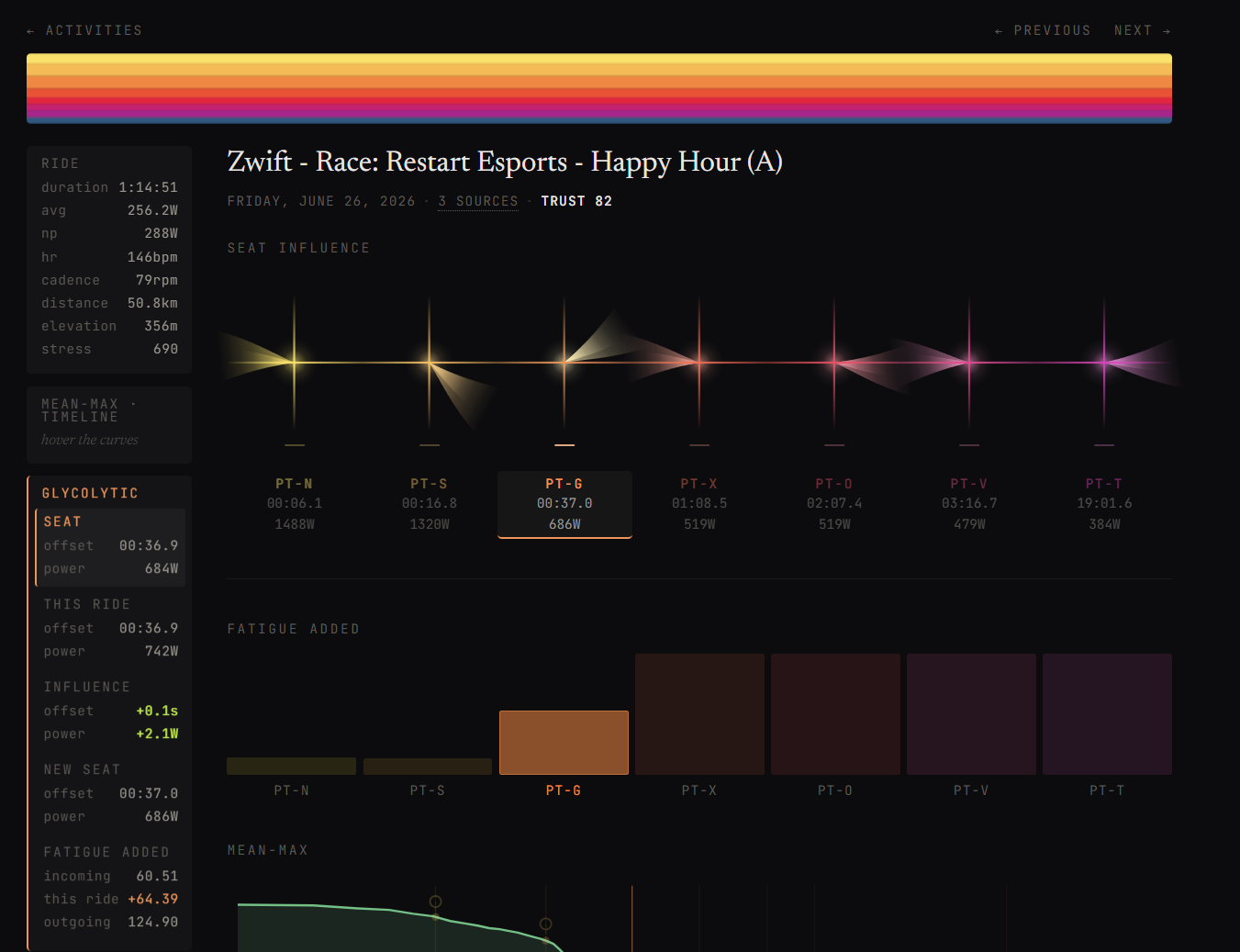
The panel reports three things about the glycolytic seat. It came into the race at 36.9 seconds of offset and 684 watts. During the race, the athlete produced 742 watts in the glycolytic window, fifty-eight watts above the seat. And after the ride, the seat reads 37.0 seconds and 686 watts: an offset extension of a tenth of a second and a power gain of two watts.
The power change is the familiar kind. The glycolytic threshold is two watts higher than it was. The offset change is the new one, and it is worth reading slowly. The threshold now holds a tenth of a second longer than it did before this race. The glycolytic system's contribution reaches marginally further along the time axis before the next system takes over. Under a watts-only tool this movement has no place to appear. Here it is a number with a direction.
A tenth of a second is a small movement, and it should be read as one. A single race nudges a threshold; it does not relocate it. What matters is that the nudge is now visible and has a sign, so that many of them, accumulated across a season, become a trend you can actually see rather than one you infer from how your legs felt.
The ride is not the seat
Look again at the three numbers. The ride produced 742 watts. The seat moved to 686. The effort was fifty-eight watts above the seat, and the seat moved two. That gap between what the athlete did and how far the seat moved is not noise, and it is not an error. It is the whole idea.
A seat is not a record of what you produced in one ride. It is a measurement of your fitness at that threshold, pooled across your history and weighted toward the recent. A single hard effort does not set the seat. It influences it. This race entered the pool alongside every race and every ride before it, and the seat that resulted reflects where the glycolytic threshold actually lives in your settled physiology, not where it spiked on one competitive afternoon.
This is the difference between a training record and a fitness measurement. The training record is what happened today: 742 watts in the glycolytic window. The fitness measurement is what that effort, combined with everything that came before it, means for where your glycolytic threshold now lives. Your power file gives you the first. A seat gives you the second.
The same is true of offset. The race did not set the offset to 36.9 seconds. It influenced a seat already at 36.9, and the result was a tenth of a second of extension to 37.0. Offset is a fitness coordinate in exactly the way power is. It reports where the threshold's duration lives, not where it happened to fall in one race.
This is why the reading is an act of self-assessment rather than record-keeping. The seat is not the ride you just finished. It is a description of you, assembled from the efforts you have actually made, and it answers a question a single power file cannot: not what you did, but what you are currently capable of, and in which direction that is moving.
When power falls and the threshold still extends
Eight days earlier, on June 18, the same athlete raced the Restart Esports Thursday Thumper: fifty-five minutes, 254 watts average, 299 normalized. A different course, the same seat selected afterward.
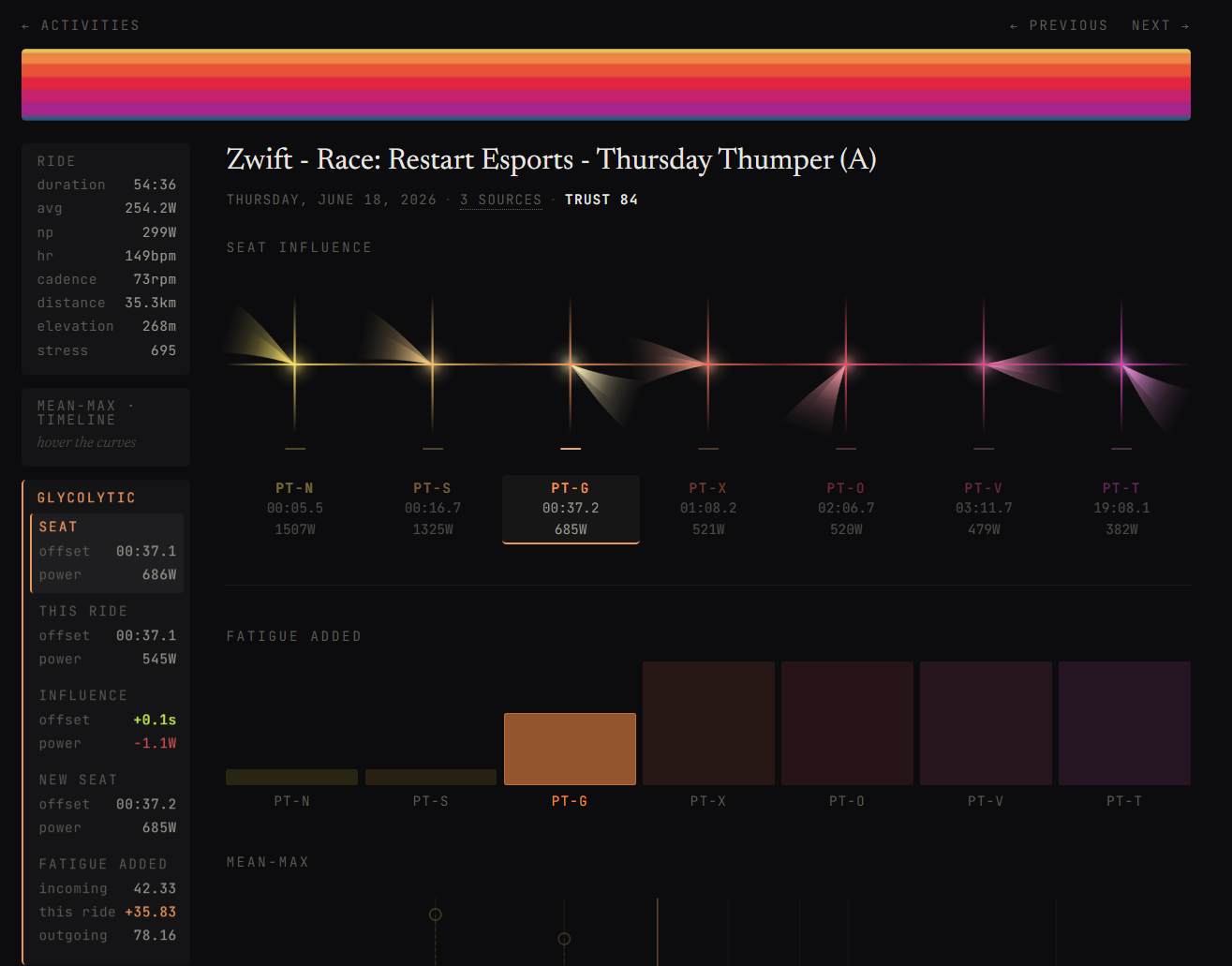
The glycolytic seat came in at 37.1 seconds and 686 watts. The athlete produced 545 watts in the glycolytic window, well below the seat. The influence reads a tenth of a second of offset extension and a loss of just over one watt of power. The seat moved to 37.2 seconds and 685 watts.
A rider reading only power sees a small regression: the glycolytic threshold gave back a watt. But the offset extended by the same tenth of a second it would extend eight days later. On both days, in this seat, the threshold held for slightly longer than before.
Same seat, same offset extension, opposite power story. A watts-only reading scores the first race as a loss and the second as a gain. The offset reports that the glycolytic threshold extended in both. The duration it holds grew slightly longer regardless of which way power moved on the day.
Two dimensions give the word "progress" a second axis. Power rising is one kind. Offset extending is another. Power falling while offset extends is a third, and which of these matters most depends entirely on what the rider is training toward. The question is no longer only whether watts went up or down. It becomes: where did the seat move, and does that direction serve what this athlete is trying to build.