Your FTP is a seat
Every cyclist who trains with power already reads one seat. You call it FTP. It is a single threshold's power, pinned to a single assumed duration, and it has quietly anchored your zones, your intervals, and your sense of progress for years. The Power Threshold Array measures that same kind of number at seven thresholds, and then it does the one thing FTP never did: it lets the duration move.
You already read one seat
FTP is the watts you can hold for a long, steady effort: the number you test for, set your zones from, and watch across a season to know whether the work is paying off. It belongs to the threshold end of your efforts, the long, grinding end where aerobic fitness lives, and for most riders it is the one fitness number they could recite from memory.
In PTA's vocabulary, that number is a seat power: the power at a single bioenergetic threshold. You have been reading a seat this whole time. You just had one, and you called it FTP.
Having only one is the problem. Everything between a five-second sprint and a twenty-minute climb gets quietly compressed into a single proxy, as though one watt number at the aerobic end could speak for the whole shape of a rider. It cannot. It was never built to.
Now read seven
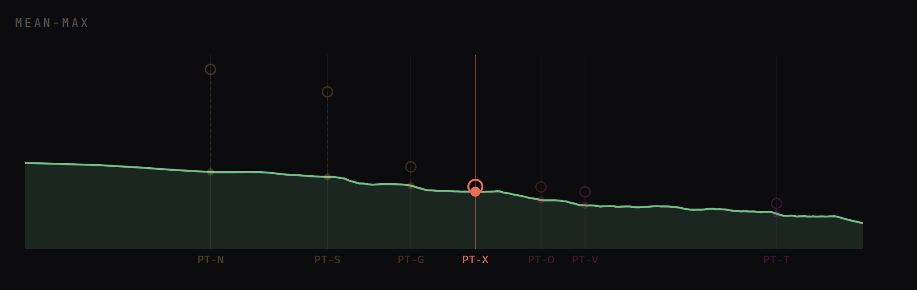
PTA does not replace FTP. It generalizes it. The same kind of measurement, watts at a physiological threshold, taken at seven places along the curve instead of one. Each of the seven marks a point where one energy system hands off to the next.
They run from the neuromuscular snap of a standing sprint at PT-N, a handful of seconds long, through the glycolytic burn of PT-G and PT-X in the tens of seconds, into the aerobic and threshold end at PT-V and PT-T where your FTP already lives. Seven watt numbers, none of them any stranger than the one you already test for. No new concept yet. Just more of the curve made visible.
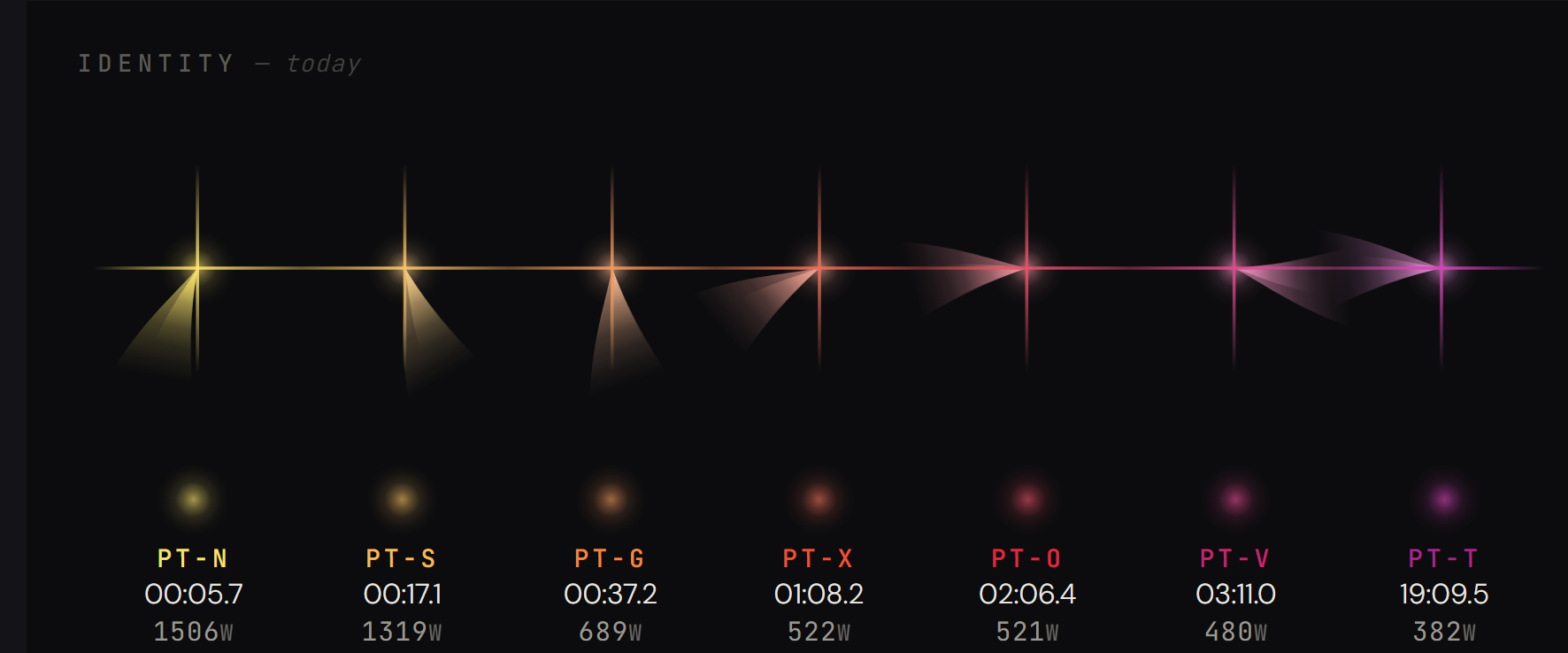
The threshold seat, PT-T, is the neighborhood your FTP already occupies. The other six were always there underneath your training. They were simply never measured, and so the work you did at every duration but one was being judged by a number that could not see it.
The number FTP hides
Here is the part FTP never told you. Your FTP is a watt number, but it is also a duration: the length of effort the number is supposed to describe. By convention that duration sits somewhere near an hour, often estimated from a twenty-minute test. And for the entire history of the metric, that duration has been treated as a constant, a fixed assumption baked in so deep that most riders never think of it as a number at all.
PTA stops treating it as a constant. For every seat it measures not only the power but the offset: the duration, in seconds, at which that threshold actually fires for you. Not the duration the textbook assumes. The one your physiology demonstrates.
And the effect of measuring it is that a number you assumed was fixed turns out to move. The length of time your threshold holds is itself trainable, and it shifts on its own schedule, sometimes climbing alongside power, often pulling against it. This is the half of the picture FTP structurally cannot show, because FTP resolves the duration by assuming it away.
FTP gave you one axis: watts. Offset adds the other: time. A seat is the two together, a position rather than a point value, and reading both is the difference between knowing how strong a system is and knowing how strong it is and how long it lasts. One axis you have read for years. One you have never seen.
Watching one seat move
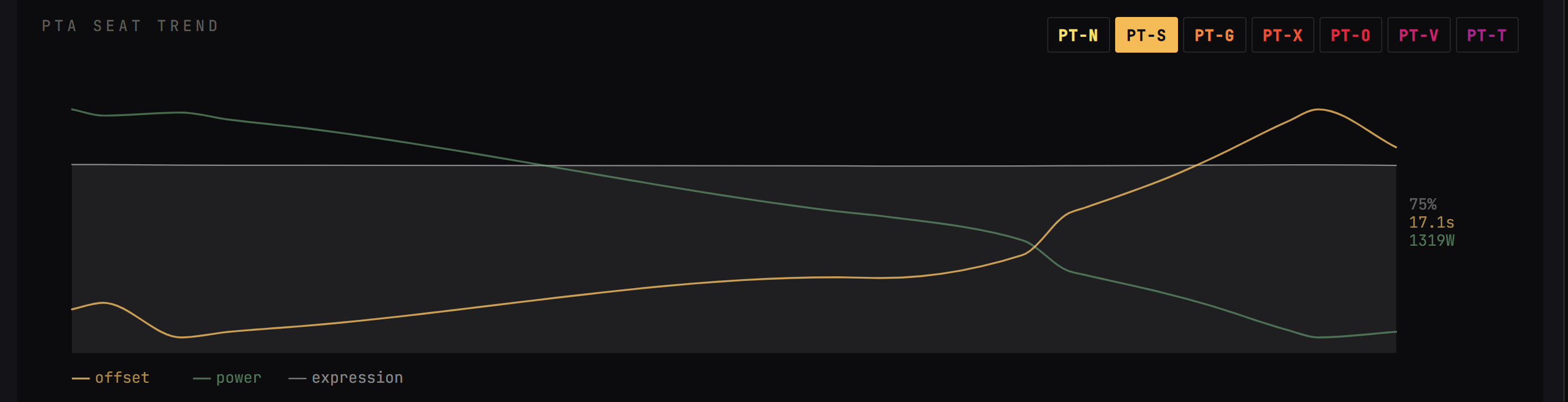
The Seat Trends page in the Raceproof app is where the second dimension becomes legible. It gives each of the seven seats its own panel and plots two lines through it: the offset line in the seat's own color, and the power line in green. They are drawn apart on purpose. A one-number metric earns its simplicity by dropping one of these dimensions entirely, and keeping both lines on the panel is what makes the dropped one visible.
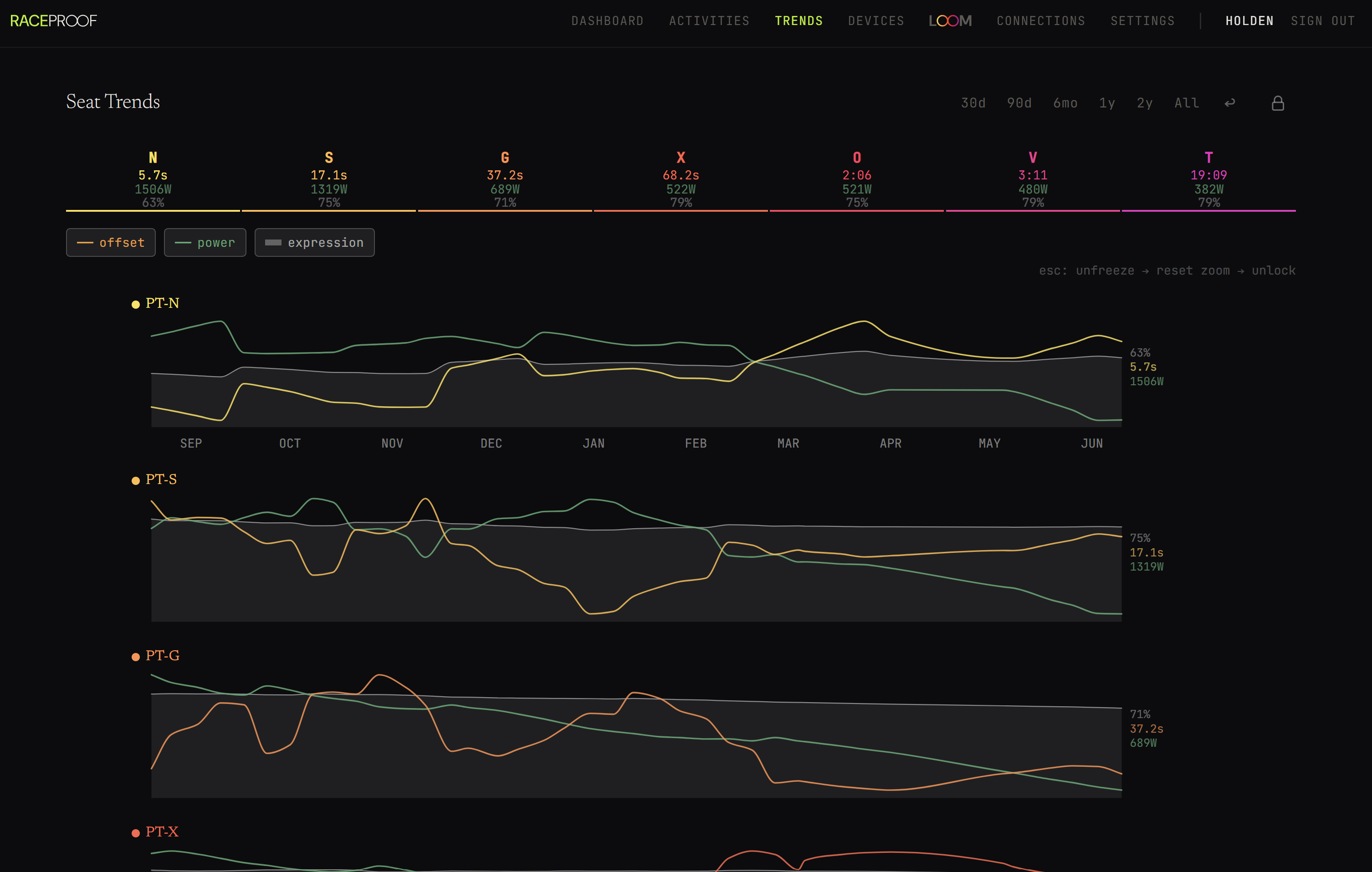
Read the summary row across the top and the standings are plain. This athlete's PT-V, the VO2max seat, is 480 watts and a 3:11 offset. The threshold seat nearest FTP, PT-T, is 382 watts and a 19:09 offset, a reminder that the duration a threshold actually holds is a measured quantity that need not match the hour FTP assumes. Up at the short end, PT-X holds just over 520 watts at roughly 68 seconds. Seven seats, two coordinates each, all on one screen.
The gray band running underneath each pair is Expression, a single figure that resolves how fully a seat is realized across both dimensions at once. Its job is to settle the question a power line alone can never answer: when watts climb while the offset gives ground, did the seat actually move forward, or did it just trade one kind of fitness for another? The band tells you which.
Once you have two lines instead of one, the moments a single FTP-style number would have flattened into noise become separate, readable events: the winter where power surged while the offset quietly shrank, the spring where the offset stretched while the watts held steady. Neither is visible in a power-only view. Both are visible here.